Showing posts with label healing stories. Show all posts

Wednesday, April 29, 2015

Petra the Statue: A healing Story about Perfectionism


There once was a beautiful green park. And in this park there was a path that wound through it, past all the tall trees and beautiful flower gardens. And just off that path was a fountain and in the middle of that fountain was a statue. Now this statue was a very large and very beautiful statue of a water nymph. She had beautifully chiseled long hair and graceful arms held out like she was stretching to hug the morning sun. From her mouth came a gentle stream of water falling into a small reflecting pool below. Her name was Petra and a very famous sculptor had lovingly carved her many years before and gave her as a gift to the city.

Everyone loved to gather around this fountain. Grandmothers would sit along the benches and read and relax. Mothers would bring their children to play tag around the circle of the fountain. Young lovers would hold hands and whisper to each other. Every day at least one person would stop and look at Petra and say, “This is the best place in the entire park. What a beautiful fountain.”

The air was always full of laughter and everyone was smiling. Petra loved being the reason they all came. She was proud to hold her arms out always as if to say, “Come here, children. Come and play.”

There was only one problem. Her beautiful, pale gray arms were the perfect landing spots for pigeons. Every day, soon after the sun rose, a pigeon would land on her outstretched hand. And then another and another until her arms were quite filled all the way up with pigeons. And when those were full they began to perch on her head.

One pigeon cooing is not altogether terrible, but ten or fifteen gets to be quite a cacophony. All day Petra heard them cooing and calling back and forth to each other, right by her ears. And she couldn’t cover her ears because her elegant and slender arms were made of stone and could not bend. She couldn’t wave the pigeons away because her stately shoulders were made of stone and would not flex.

Even all that perching and cooing would have been tolerable if it hadn’t been for the mess those birds left behind all over her arms and head. White streaks and spots all over. “Oh, my beautiful gray arms,” wept Petra. “They are all striped and splotchy now. I feel certain the sculptor who made me would be horrified to see me looking this way. I am a work of art and they are ruining me! Oh, soon nobody will want to come spend their day at the park near me. I will just be an awful mess!”

But one day, Petra realized she could fight back against the birds. One morning, a pigeon flew by and its wing brushed her nose and made her sneeze! Well that sneeze shot the trickle of water coming from her mouth straight out! It hit the pigeon square in the beak and it flew off, determined to never return to the cursed fountain again.

Petra had never thought to use her water fountain to shoo away the birds and her heart skipped a beat at the though. “Oh, once again I shall be beautiful and stately, just as the sculptor intended me to be.”

So one by one that day, Petra squirted each pigeon that dared to land on her graceful arms. It was a lot of work, because pigeons are not naturally intelligent creatures and many of them had to be reminded several times what would happen if they came back to their favorite landing place, but Petra was determined to be rid of the birds once and for all.

For a week Petra fought the battle of the pigeons, but by the end of the second week, not a bird dared to touch down anywhere near her. So focused had Petra become on ridding herself of the flying nuisances that she would even squirt them for landing on the edge of her fountain or on the sidewalk nearby.

“Aaahh,” Petra said at the end of her first day with absolute zero pigeons. “This is how I was meant to live. The sculptor would be very proud to see me now.”

But Petra’s happiness was short-lived. Only a few weeks after scaring away all the pigeons Petra looked around at the park benches surrounding her fountain and noticed that none of the old grandmas were sitting there anymore. For you see, the grandmothers had always come to feed the pigeons and once the pigeons left, they found another place to sit and relax and empty their purses of bread crumbs and bird seed.

Petra was a little sad, but she simply sighed and said, “Oh well. At least the children will still come and see me.”

But after a few weeks, the children no longer ran around her fountain laughing and playing and throwing in shiny pennies and wishes. For you see, the mothers and children came to visit the grandmas who would open up their purses full of bread crumbs and bird seed, but also full of little candies and chocolates.

Petra was quite sad now, but she simply sighed and said, “Oh well. At least the young lovers will still sit on the park benches and admire my beauty as they hold hands and whisper.”

But a few weeks later, the young couples no longer sat on her benches to hold hands and whisper. For you see, they’d always been whispering about a future with children and growing old together, and it was always food for their imaginations to watch the cycle of life before their eyes and dream about it together.

Now Petra was really, very, very sad. She wanted to cry great sobs but because she was made of stone all she could do was let a little more water pour down from her mouth. “Oh, if only I had let those pigeons stay,” she said. “I guess they were a small price to pay for all the joy the brought. And what good are my lovely, slender arms, even if they are clean now, without children and grandmothers, and young lovers to see them?”

Just then, a small pigeon flew by and Petra stopped her stream of water long enough to let out a small bird whistle. She was in luck, because this bird was new in town and did not know about Petra’s reputation for squirting loud and dirty birds who dared to land on her. So the small pigeon decided to stop and rest on one of the graceful gray arms for a bit.

Petra stayed very still.

Soon, a flock of pigeons flew by and saw a bird on Petra’s arm. They wondered how this could be and flew down to get a closer look. When Petra saw them coming closer she once again stopped the water coming from her mouth as a sign of goodwill and to show that she promised never to squirt them again. The pigeons all landed on her arms and head because really, they had missed their favorite perch. The cooed together and left many a white streak and splotch before flying to their nests for the night.

But in the morning, they were back. And the next day and the next day. And soon, Petra saw an old grandma sit down on the park bench, open her purse and begin to feed the birds. “Yes,” thought Petra. “Yes, soon everyone will be back.”

And soon, they were. The children, the mothers, the grandmas and grandpa, the young lovers. All sitting and smiling or running and laughing. “This is the most wonderful spot in the park,” she once again heard them say. “What a beautiful fountain.”


And Petra learned to love the pigeons, no matter how loud or dirty they were. Because even though they made her less than the perfectly, beautiful statue she’d started out as, she became much more when they were around. She became a centerpoint for love and life. And that’s really much better than being perfect and beautiful, don’t you think?

Sunday, April 19, 2015

A Story for Yosemite Falls

A trip is always made more magical for young children with some good stories. Tell a story about a place you are about to visit and watch your children notice all those special things you mentioned or ask where that special fairy might be hiding.

Well, our favorite place is Yosemite and over the next few weeks I'll be writing some stories here for my kids (and for yours too, if you want.)

The first story is for all those beautiful waterfalls in Yosemite. But especially the big Yosemite Falls.


Once upon a time there was a great mountain mother named Lyell. She took good care of all her children, the fairies and gnomes, the butterflies and bears, and even the ducks that visited her mountain lakes. All her children loved her too. But the one who loved her best of all was a little fairy named Lana.

Lana was born in the early spring, right in the center of a Mariposa Lily. She had a bright orange dress but never really fit in with the other fairies because one of her wings had a small rip and so she couldn't fly. But Lana wasn't lonely because she was always asking Mother Lyell how she could help. "May I make you a crown of wildflowers Mother Lyell?" she would ask. "Do you need me to ask the clouds to rain on your dry spots? " "Should I turn the leaves of the trees orange and yellow now?"

And every time Mother Lyell would reply, "Yes child. Thank you for always helping me."

And then Lana would wake up the seed babies to make a beautiful crown of wildflowers, yell up to the sky and call down the rain, and shimmy up every tree to change the colors of the leaves.

Then the winter snows came and Mother Lyell seemed to grow old and age all at once. Her head was crowned with bright, white snow for hair and her rocks creaked. The trees and the wildflowers and the grass and the seeds all lay fast asleep beneath the great drifts of Mother Lyell's snow, white hair. All her children went into their dens for a long winter nap and then Mother Lyell herself began to lightly snore.

All the other fairies flew down the mountain and away to the warmer places where they could still fly among the orange trees and sandy beaches. But not Lana. She was left all alone.

"Mother Lyell?" She called. "Mother Lyell, do you need anything?"
But Mother Lyell never said anything, she just continued to sleep. An evergreen tree hear Lana's cries and shook her branches. "Come here, child. Come here. Winter is a time for rest. But do not worry. You will be warm beneath my boughs and soon spring will come again and all the world will wake. Even Mother Lyell."

Lana nodded and crawled underneath the kind fir and nestled in the pine needles. She slept restlessly all winter. Waking up and checking to see if Mother Lyell was awake yet.

"Not yet," the tree would say. "But soon. Soon dear."

Then one day, Lana felt the ground beneath her and it was warmer. Not warm like in the spring and summer or even fall, but not quite so cold. She put her ear to the ground and listened. "Are you awake Mother Lyell?"

"Yes," she whispered.

Lana was so excited, she dashed out from beneath the pine tree. "Tell me what you need Mother Lyell. How can I help you?"

Mother Lyell wheezed out a quiet laugh. "I feel the spring coming," she said. "And in the spring I put on a lovely green dress lined with wild flowers. But look at my hair. It has gotten so unruly!"

Lana looked toward the top of Mother Lyell and she was right. The snow lay in great huge clumps all around.

Do you think you could brush my hair out, Lana? Brush it out into the rivers and streams and lakes that is used to be."

Lana's heart felt suddenly warm. "I would love to!"

"Here," said the pine tree shaking a bough. "Take one of my branches. I have kept it warm and alive all winter. It will be perfect."

Lana snapped off the branch and went to work. She climbed up to the very top of Mother Lyell and started running that warm pine branch all over the snow. She called up to the sun. "Mr. Sun! I need your help to comb Mother Lyell's hair." And even though the sun still was not as warm as in summer, he shone a little brighter.

Slowly, slowly, and little by little, Lana combed out Mother Lyell's hair into great, beautiful, blue trickles running down her sides. And then she combed out more and then become streams, and then creaks. And then after several weeks Lana had combed so much of Mother Lyell's snowy hair that they joined together into a beautiful river.

But Mother Lyell's hair was so long. It jsut kept stretching on and on. And one day as Lana was combing it out farther and farther away, she came to a steep cliff. "Oh no," she thought. "What will I do? I have no wings to take Mother Lyell's hair over this cliff." Lana looked over the cliff again and it was so far down. She sat on the ground and began to cry. What would Mother Lyell say? Already she was beginning to put on her beautiful green dress.

Suddenly, Lana heard a voice. "I can help you."

Lana looked and saw a small rainbow. "I can give you a ride down the cliff," said the rainbow.

"Really?" Lana wiped away her tears and hopped onto the smooth, dewy surface of the rainbow. And then Lana and the rainbow led Mother Lyell's lovely, blue river of hair over the edge of the cliff. It fell, fell, fell with a great CRASH against the rocks below.

"Thank you!" said Lana with a clap of her hands.

"We aren't done yet," said the rainbow. "Look."

Lana looked down and saw ANOTHER cliff. "I'll help you down that one, too," said the rainbow.

And it did. Mother Lyell's brlue river now cascaded beautifully over the upper and lower cliffs and into a valley. Lana looked around and saw that as the water from Mother Lyell poured into the valley, everything became green and woke up. And it was beautiful.

"Where are we?" asked Lana.

"Yosemite Valley," said the Rainbow.

"It's beautiful."

"Yes, it is."

From then on, Lana stayed with the rainbow by Yosemite falls every spring and early summer. In the late summer she'd return up the mountain and in the fall help Mother Lyell get ready for her long winter's snooze. Then in early spring she combs out her hair all over again. You might see Lana when you go to visit Yosemite. Just look for a rainbow in the rushing, misty water. That's Lana, brushing a snarl out of Mother Lyell's hair.

Saturday, February 14, 2015

Why does the ocean have waves?

I have a bachelor's degree in chemistry. Rob has his in neuroscience, not to mention all the science classes he had to take in dental school. We. love. science. And I've always dreamed of introducing my kids to the wonders of science. And for many years, I've tried. Oh, how I've tried.

But guess what? A four-year-old just isn't going to understand the world of atoms and hydrogen bonding and electrons, no matter how simply you explain it. I can explain to Jane (6) about how the sky is blue because of the size of particle in the atmosphere that bends light at just the right angle. But let's be honest, I barely understand the intricacies of that answer. I know she doesn't. And for a child, who still sees the world as a place full of magic, still believes in fairies, Santa, and talking animals it's a terribly disappointing answer.

I had to remind myself recently of one of my favorite quotes from A. A. Milne's Winnie the Pooh. "Rivers know this: There is no hurry. We shall get there someday."

And we will. One day I will sit across the table from Jane and squeal about the amazing qualities of water and the "magic" of that 104.5 degree angle.

But not yet. Because right now, Jane still loves to hear about water as a living, breathing, thinking thing. She still sees the bees and the butterflies as playmates. And she desperately wants to find a fairy.

And so for now, I preserve the magic. Oh, I give them what they are ready for. We practice observation and experimentation. We explore the science that is happening all around us, the blooming flowers, and buzzing bees. The butterflies, earthworms, and bird nests. What we can see and touch.

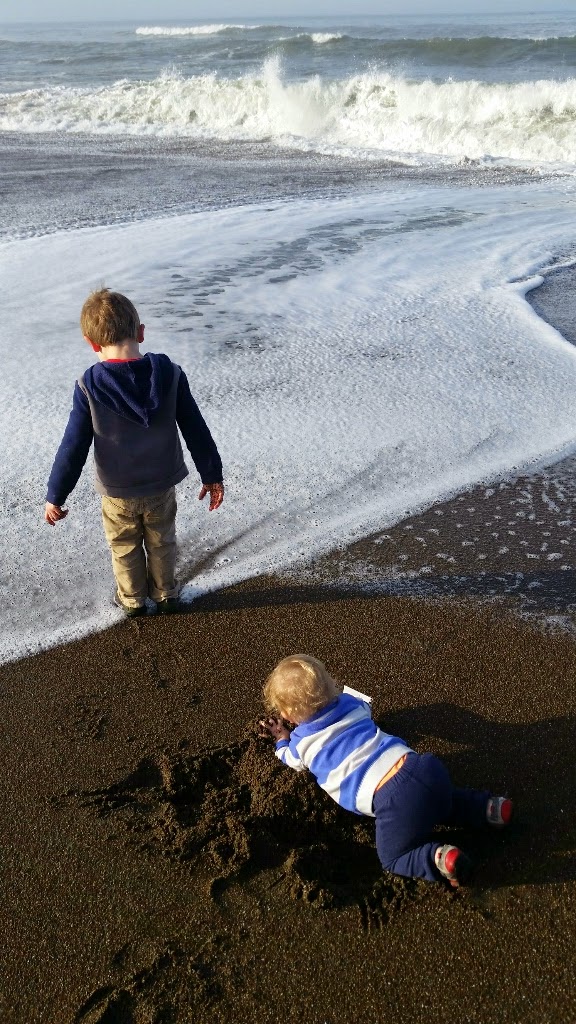
So today at the beach, when my children were mesmerized by the waves, instead of lecturing about the gravitational pull of the moon and the tide and the physical and mathematical properties of waves, I told a story. And it went like this.

A long, long time ago, when the earth was still very young. Before there were humans or even animals. The sand and the ocean were best friends. The played together, and told jokes, and laughed and laughed.

Then one day, Ocean said, "Sand, you are my best friend and so I am going to show you my greatest treasure." And with that, Ocean pulled out the most beautiful, white shell.** It was round and smooth and sand just had to have it.

"Oh, please let me hold that shell," said Sand. "Please."

"No," said Ocean. "It's my greatest treasure. Nobody can touch it but me."

"Please," said Sand. "Please, please let me hold it."

"No," said Ocean. "It is too precious to me. I don't want to lose it."

Then Sand got angry and yelled and stomped. "Let me hold that shell or I won't be your friend anymore!"

Ocean didn't want to lose his best friend, so he gave Sand the shell. "Just for a little bit," said Ocean. "Then give it right back."

But when Sand held that beautiful shell, he knew he could never give it back to Ocean. He wanted to always be able to look at it.

"Okay, give it back," said Ocean.

"No," said Sand.

"Give it back now!" said Ocean.

"No," said Sand.

The Ocean screamed, and kicked and threw a glorious fit. "Give me back my shell or I won't be your friend anymore!"

But instead of giving back the shell, Sand threw it into the air and it got stuck in the sky. Sand rejoiced. Now he could always see that beautiful shell and Ocean couldn't take it back to his dark, watery depths!***

But Ocean let out a loud roar. "No! Shell!" He reached, reached his wet, foamy hands out and out. But they couldn't reach the shell in the sky. But Ocean couldn't give up. To this day, he still reaches his watery hands up over Sand, reaching, always reaching for his shell, which we now just call MOON.

**Rob pointed out that this would probably work better as a pearl.

***I originally had this go so that Ocean didn't see what Sand had done with the shell, and so the waves are really Ocean searching through the sand, looking for his shell, thinking Sand has hidden it somewhere. He finds many, many shells, but not HIS shell. This version is kind of fun, as today Jane was sure we'd found Ocean's shell and she kept shouting "I think the Ocean is mad at us now!" as the waves washed over our feet. You choose which you like best! I added the moon bit in because I can't help sneaking a tiny bit of science in there.


Tuesday, January 20, 2015

A story for patience: The Little Caterpillar

Being on internet forums is one of those things that can be extremely helpful, but sometimes frustrating. I set out to write this story to address my daughter's whining about doing chores. When I asked for help on a Waldorf forum, I was met with some advice that I didn't want. At first I bristled. Jane's problem with chores lately, had nothing to do with my rhythm, or her development. Why won't these people just answer the question I asked!

It can be hard to put yourself out there on the internet, especially when you feel surrounded by people who know more than you, or who don't know your situation but seem to be passing judgments. But then, I made myself take a step back. I was not being judged as a mother. These women were trying to help. And I should be humble enough to consider their advice.

And really, when I thought about some of it. I realized some of it was true. I might not have wanted to hear it, and I may not use all of it. But it's okay to rethink your position or what you're doing. It's okay to re-evaluate.

As I pondered my story a bit more, I remembered what I had begun writing it about, and it is a vein that that sometimes affects daily chores, but it affects so many other things with Jane right now. And that theme is impatience. Everything is going to take too long or be so boring. She complains about everything. How long the car ride is, or the wait before the next holiday, or even the length of time before quiet time.

So, I began writing this story with the idea of patience in mind, rather than work. And as I wrote it tonight, I realized, this wasn't just going to be a healing story for Jane, but for me as well. It helped me take a deep breath and push away those thoughts that creep into our minds so often. PUSH, PUSH, PUSH. Is she learning enough? She should be reading now! And helped me to remember that there is wisdom in the waiting, the unfurling, the change.


So without further ado, here is the story.

There once was a little caterpillar, who loved to run and play with all of his friends in the garden. They would play chase, and hide and seek, and mother may I all day long. Sometimes, caterpillar was having so much fun, that he didn't even want to stop to eat. But all his other little caterpillar friends were eating. More and more they were eating each day. Munching away. And soon, they weren't playing as much. One day, all the other caterpillars, climbed up a tree and hung upside down from the branches.

"What are you doing?" Little Caterpillar cried. "Let's play. The sun is shining bright and you're just hanging there!"

"We're making a cocoon," they replied. "In a few weeks, we will be beautiful butterflies."

"A few weeks?" whined little caterpillar. "But that's so long! And sitting in a cocoon sounds so boring!"

The other caterpillars just laughed and sang,

Silly caterpillar, Try not to whine and cry.
You need a little patience, to become a butterfly.

And no matter how Caterpillar whined and moaned and begged his friends to come back and play with him, they simply would not and soon they were all snug in their cocoons, and could not talk at all.

"Hmph, well I'll just find someone else to play with," said little Caterpillar. He creeped off to another corner of the garden, next to some big, red tomatoes, where he found a little garden fairy.

"You stay away from these tomatoes," said the little garden fairy. "I've worked very hard to make them nice and plump and juicy."

"I don't want your tomatoes," said little Caterpillar. "I want to play. Will you play with me?"

The fairy fluttered her silvery wings. "Yes! I love to play. Let's have a race, shall we?"

"Okay," agreed little Caterpillar. He always loved a good race. "How about all the way to the radishes?"

The fairy agreed and off they went. Little Caterpillar did his best to keep up, but he had so many rocks to climb over and the fairy just zipped through the air. She beat him by a mile. When caterpillar finally made it to the first radish, he was tired and out of breath.

"It's not fair," he whined. "You can fly and I can't."

"Sorry," said the fairy, for she was truly a good natured soul and didn't want anyone to feel sad. "But one day you will have wings like me, when you are a beautiful butterfly. And then we can race again and see who wins."

"Oh, that will take too long," whined the caterpillar. "I want to win a race now! Not when I'm a butterfly."

The fairy laughed as she flew away and chanted.

Silly caterpillar, Try not to whine and cry.
You need a little patience, to become a butterfly.

Little Caterpillar looked up at the tree and all his friends hanging in their cocoons. It did seem nice, to be able to fly. But, oh, wouldn't it be so boring to just hang around in a sack doing nothing? The thought was so horrible, that little Caterpillar began to cry.

Just then, a beautiful butterfly with lovely, purple wings fluttered past little caterpillar. "Why are you crying?" he asked.

"I want to become a butterfly so I can fly fast and play with my friends, but...I don't want to sit in a cocoon for so two weeks. It's so long. And so boring!"

The butterfly said, "Oh, I understand. But really it's not boring at all. Because the whole time you're in you're cocoon, your body is growing the most beautiful wings. And your brain is learning how to flap your wings and fly, and get nectar from the flowers. The waiting is the most important part. Otherwise, what kind of butterfly would you be, but one that can't fly or play?"

The caterpillar thought about that for a moment. "Well, I do want to be a butterfly that plays and flutters."

"Of course, you do," said the butterfly. "Now get up there and make your cocoon."

With that the butterfly flew away and Little Caterpillar started climbing up the tree. He chanted to himself.

Come on Caterpillar, today's your day to try.
It takes a little patience to become a butterfly.

Butterfly hung himself upside down, and wrapped himself up nice and tight in his cocoon, and for the next two weeks, he waited, and grew, and learned, and changed. And finally, FINALLY, the big day arrived. Caterpillar broke out of his cocoon, unfurled his wings and flew into the bright blue sky. His friends had already emerged and he went off to find them, ready to play and race and explore.

The end.