Wednesday, April 2, 2014

Dreaming: The first step


This weekend I am going to a writing conference. The thought both excites and terrifies me. I think that's the way most things are in life. At least, the things that are worth doing. Writing is something I never thought I would do. Something I never thought I would like. And here I am, and Saturday feels like a huge, gigantic, big step.


You see, I've been writing for almost two years now. I've had several small successes. Enough to energize me and keep me going. I've received enough positive feedback to make me feel like I'm not absolutely horrible. I've received enough rejection to let me know I'm not great and to encourage me to keep working and learning.

But this conference is scary.

Why is it so scary?

Because even though I've been writing almost daily for the last two years, and submitting and critiquing, and getting rejected, and revising, over and over and over again...I could always view it as a hobby. Something I just did for fun. A nice outlet, I would call it. A fun adventure, something new. That way I could blow it off.

Rejected? Not a big deal. I don't take this writing thing too seriously. It's like crocheting or cooking a new recipe. Just something new to try.

But I just spent two hundred dollars. I've submitted for critique a novel I've been working on for the last 18 months. Suddenly this is not just a hobby.

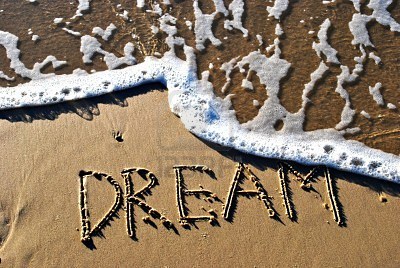
It's a dream.

I admitted to myself that I had this dream a while ago. But going to this conference is like admitting it to the world. Sometimes, when I admit it to other people, I still feel a little silly.

And yet, admitting it makes it real. Talking about it is like lifting a burden.

Yes, I'm a dreamer. I work hard at a goal that might never be realized. I take that risk every day. The risk that I will put in countless hours for what may seem like "nothing" to the world.

But even if that impossible dream never comes true. At least I have it. I don't need to be ashamed of it. And even if I don't "make it," I've learned so much, not just about writing, but about learning, and setting goals, and networking, and just plain, flat trying something new.

The truth of it is, allowing myself to have a dream, admitting it to the world, is the first step in getting there.

Hi, my name's Amanda, and I have what oftentimes feels like an impossible dream.

And it's exhilirating.

And suffocating.

It's freeing.

And it's hard work.

Now it's your turn. Do you have a dream?

Tuesday, April 1, 2014

Preschool/Kindergarten Music Appreciation: B is for Beat

B – Beat, My Bonnie Lies Over the Ocean, Beethoven


If you missed the music appreciation lesson, "A is for Accelerando" you can find it here.

Sing your gathering song

Introduce the Words for the Day
Beat – The steady rhythmic units that dictate the speed (tempo of a piece). When you clap along to a song, you are clapping the beat. This is probably more easily demonstrated than explained.
Rhythm – The rhythm is the way the music moves through the beat. Think of My Bonnie Lies Over the Ocean. When you sing this song, your body starts swaying almost involuntarily along to the beat. However, the words/notes do not follow the swaying, they move through it. The way the notes go is the rhythm.

Activity
Do a “military cheer” to illustrate the differences between rhythm and beat. Have the kids march in place. Their feet are stomping the beat. Now you call out a cheer that your kids can repeat. This one is easy.
I don’t know what I been told,
(I don’t know what I been told)
That tuna fish is smelling old!
(That tuna fish is smelling old!)
I don’t want to eat it! No!
(I don’t want to eat it! No!)
That tuna fish has got to go!
(That tuna fish has got to go!)

Now say the rhyme again, with children still stomping, but change the rhythm of the words. I give a few different examples in the movie below. Explain that the rhythm is changing, even though the beat always stays the same.

 Excuse my laughing at the end. Jane called from her bedroom, "Why are you talking to yourself?" Ah, kids.

Another activity your kids might like is to have a body percussion “concert.” Have everyone march in place. One person “conducts” a rhythm by clapping it and then everyone else copies it. Continue until everyone gets a chance to clap a short rhythm. I demonstrate a few easy rhythms
below.


Learn the New Song

My Bonnie lies Over the Ocean
In the chorus, which words fall on the beat? Which don’t?
Some people think this song was written after a “prince” (Charles Stuart, known as Bonny Prince Charlie) was defeated and exiled from Scotland. His supporters would still sing it. However, Bonnie could mean either a girl or a boy and so they could pretend it was a love song. What if you changed the word Bonnie to “Bunny?” Would the song have a totally different meaning? Try singing the song with a different word. Bunny, Mommy, Tummy. How silly can you make it? This is called a parody.  To hear the song, go to https://www.youtube.com/watch?v=Io9MPyXE2K0
My Bonnie lies over the ocean
My Bonnie lies over the sea
My Bonnie lies over the ocean
Oh bring back my Bonnie to me 

Chorus
Bring back, bring back
Bring back my Bonnie to me, to me
Bring back, bring back
Bring back my Bonnie to me 

This song is fun to sing while you hold hands and sway back and forth. Lean your head back and belt it out!

Sing the song through a couple more times, but have someone hold up one of the "flashcards." The ones for this lesson can be found here. Be sure to use the cards from A is for Accelerando, too. While singing, obey the command on the card. This is built in review!

Introduce the Composer

Beethoven – I’ll be honest, it was hard to choose a composer for the letter B. How do you choose between Beethoven, Bernstein and Bach? (You move Bach to J and Bernstein to L.)
When Beethoven wrote his music, it was considered strange and pushing the boundaries of music, even though today it sounds very classical. His music was full of emotion, indeed, Beethoven was often known as very impassioned. He would frequently get angry and later apologize. All was excused because of his great talent.
Just before he wrote his first symphony, Beethoven began to go deaf. The last ten years of his life he was completely deaf. And yet, he wrote some of the most beautiful and famous pieces of music in the world. Beethoven knew music so well, that he could probably hear the music in his head as he wrote it. But he also composed, by sawing the legs of his (four) pianos and sitting on the floor while he played so he could feel the vibrations. Often he wrote music only in his underwear!
Beethoven’s music reflects the wide range of emotions that Beethoven himself felt so deeply. Listen to excerpts from two of his pieces, “Symphony No. 5” and “Ode to Joy.”  How does the music make you feel? Which one is happy? Which is anxious or angry? Have the children act out the emotions of the music. Can they dance angry? Sad? Happy?
Ode to Joy - https://www.youtube.com/watch?v=hdWyYn0E4Ys  (Skip to 7:00)

Remember, there are no right or wrong answers. If your child thinks “Ode to Joy” sounds angry, don’t correct them.


Sing Requests

You can use the flashcards while singing requests, too!
Thursday, March 27, 2014

A time to imagine...

Kids ask tons of questions. And at some point, they're ready for the real scientific answers. But as parents, we need to be discerning of when that is. Sometimes, they just need room to imagine. There's a certain beauty in leaving a question unanswered. In wondering along with your child. We live in a world where all the answers are at our fingertips, but imagination and creativity are dying.
http://www.hdwallpapers.efreez.com/wallpapers/rainbow-child-1440x900.jpg

As we were driving yesterday, Jane saw a rainbow and asked me, "What does a rainbow feel like?"

What a beautiful question. Do you remember wondering that as a child? Maybe you still do. I know I still sometimes imagine walking up to the edge of a rainbow and sliding my hand across it. What would it feel like?

It was definitely not the time for science. Where is the wonder of saying, "Nothing. A rainbow is nothing more than an optical illusion caused by water and light. Even if you could touch a rainbow, it would feel like nothing. Like air. Possibly damp air."

Yuck.

So instead we dreamed. And Rob, bless his wonderful soul, went right along with us.

As for me, I think a rainbow feels like soft silk.

Rob thinks it feels like a fluffy blanket.

Jane thinks it feels like flowers.

As we drove, the rainbow came more into view. Wouldn't you know it? One end was definitely touching down in the park by our house. Of course, it disappeared as we got closer. But we had fun imagining how we could catch up to it. Those rainbows. They're wonderful, beautiful things.

One day, there will be a time for science and answers. But yesterday? Yesterday was a day for dreaming.

Wednesday, March 26, 2014

Preschool/Kindergarten Music Appreciation: A is for Accelerando


New to Music Appreciation? Check out this post for a quick run-down!

A is for Accelerando, Angels Watching Over Me, and Andersen
                Sing your gathering song.
                Introduce the word.
Accelerando – literally, to accelerate. To gradually go faster and faster
Ritardando – the opposite of accelerando. G get slower and slower.
Atempo – return to original tempo (speed)

Flashcards with Illustrations
               
Activity.
Have the kids do some sort of movement (marching around the room is always a good one. Jumping up and down, pretending to swim, crab walk, wiggling, you get the idea.) Have them do this action when you say go. When you shout "accelerando" they have to keep speeding up and speeding up until you shout “ritardando.” Now they slow down. Shout “atempo” for them to go back to the beginning speed. Continue to play this game, switching the action as needed, until the kids have had enough.
               
Learn the new song for the week.
Angels Watching Over Me is the song for the week. It is a children’s spiritual. As you’ll see in the lyrics below, it is basically a prayer and so much fun to sing! You’ll find a few different versions of the lyrics, but these are the ones I sing.
All night, all day,
Angels watching over me, my Lord.
All night, all day,
Angels watching over me.

When at night I go to sleep.
Angels watching over me, my Lord.
Pray the Lord my soul to keep.
Angels watching over me.

All night, all day,
Angels watching over me, my Lord.
All night, all day,
Angels watching over me.
If you want, discuss with your children how spirituals were sung by slaves while they worked on plantations in the south. They usually have a distinct style of a “call” and an “answer.” One person would usually sing the “call” and then everyone else in the fields would “answer.” 

Which parts of this song are the call? Which are the answer?

For more interesting information about African American spirituals as a secret code to send messages, check out the info on this site. http://www.negrospirituals.com/

Sing through the song a couple times with your kids. The words are pretty easy to learn. Give them instruments to play while you sing, have them clap their hands, or pat their legs.
The last time you sing it, designate someone to call out your words for the day. Speed up and slow down the song according to their commands (you might have to sing the song many more times now so that each child can do this)

                Introduce the Composer of the day
Joachim Andersen – He was considered one of the best flute virtuosos and composers of his time. In 1882 he co-founded the Berlin Philharmonic, where he was solo flutist and a conductor. However, in 1893 he had to resign because of a paralysation in his tongue. He then became a great teacher and composer.

Here is his piece, “Hungarian Fantasie Op. 2”  Have children listen, dance, and pretend to play the flute.   http://www.youtube.com/watch?v=Q7e1eoH8EYs

Additional words you can teach with this video: Piano, flute, pianist, flutist, duet, solo
Can you hear where there is an accelerando or ritardando?


                End by singing a few “requests.”

Preschool/Kindergarten Music Appreciation A-Z (for young children and other non-musicians)


Everyone loves music, especially children. But a lot of people, especially those with little musical background, don't feel equipped to introduce their children to music. This series of 26 music appreciation lessons is designed for you. None of the lessons require the ability to read music or play an instrument. All it takes is 15 minutes with your family!

Music Appreciation A-Z is meant to be done as a "family music night" every week to go along with a letter of the alphabet. Each lesson, you and your family will learn at least one new musical term and song, as well as get exposure to a composer and his/her music. This music appreciation is set up for young children, preschool-first grade, but there are plenty of "rabbit trails" for you to follow with older kids as well.

You don't need any instruments or musical experience to enjoy this with your kids, but if you do happen to play piano or guitar, I highly recommend buying Dan Fox's The Great Family Songbook.


My kids also love this set of percussion instruments. They're high quality and lots of fun!


(If you do decide to buy these for your family music night, I'd love it if you did so through the links here or in the sidebar!)


All of the lessons are set up as follows.

Gathering Song - You can choose which song works best for your family. We sing "Here We Are Together," but if there is one you like better, by all means do that one. I like to start with a gathering song because it eases transitions with the kids and works as a signal.

Introduce the New Word/Words - Every lesson also includes printable cards with the words and a picture to illustrate the word.

Activity - Reinforce the new musical term with a fun game or activity.

Learn the Song - I will either sing it for you so you can hear it, or provide a link, just in case you are unfamiliar with the song. I will also try to give a little history or other musical tidbit to talk about with the song, although it is totally up to you whether you talk about it or not.

Talk About the Composer and Listen to Music - The amount of time you do this depends on your kids. I will give a very brief snippet of information for you to share with your kids, as well as a link to listen to a performance of one or two of the songs. I will also give ideas of questions to ask about the music and vocab words to introduce if you so desire. Most of these pieces will be very long. Encourage your children to listen, talk about and dance to them as long as their interest holds, but do not expect to get through the entire piece with kids giving their undivided attention. To increase exposure, try playing to music throughout the rest of the week.

Sing "requests" - One of my great hopes with these family music nights is to build up a repertoire of songs we can sing as a family. When your children's interest wanes in the composer's music, reel everyone back in by singing some favorite songs. They can be ones learned in previous lessons, or anything else your family knows and loves. Sing as long as everyone is happy.

Finish Happy - Don't drag this out. Always keep it fun. End when the kids no longer seem to be enjoying singing.

Are you ready?

Our first Music Appreciation lesson is A is for Accelerando!

Friday, March 21, 2014

Are you eating cement?


Have you ever heard of 2-hydroxypropane-1,2,3-tricarboxylic acid? Probably not. Too bad you're eating it every day! This common food additive is found in all sorts of industrial products. It's used to clean circuit boards prior to soldering, and is added to cigarettes. 2-hydroxypropane-1,2,3-tricarboxylic acid is used to make cement and to prevent coagulation in the slaughtering business.

Cement? Anti-coagulation? And it's in your food! I can't even imagine the havoc this TOXIN is wreaking in your body.

It maybe approved by the FDA, but you know we can't trust them since they're in league with Big Ag and Big Pharma.

Now that you're officially scared of this terrible, terrible chemical (and let's be honest, if it's in cement that means it IS cement), let me tell you everything you're eating that contains cement!

Orange Juice!
Apple Sauce!
Soda!
Stock cubes!
Ice cream!
Tomato Based Sauces!
Mayonnaise!

People you are eating cement every single day. How can our government allow this to continue? They're poisoning us. It's in everything! As we speak it is raging through your veins, making it so the next time you get a scratch your blood won't clot! 

This is cement! It's a chemical which means it's a toxin!

Be afraid. Be very afraid.

P.S. The common name for 2-hydroxypropane-1,2,3-tricarboxylic acid is citric acid. 

PPS - Were you scared?

PPPS - I want to say that as a whole foods enthusiast, I am not a fan of preservatives. But as a chemist, I am also not a fan of these wholesale scare tactics about "chemicals" and "toxins."

Thursday, March 20, 2014

What is a "good" education?

As I've waded into homeschooling, this is something I've thought a lot about. What is a good education? Is it the ability to know thousands of facts? Do math in your head? Long division? Score high on a college entrance exam?

Sometimes, I think we've ended up on the shallow end of the education spectrum. Let me give you examples of what I mean.

I came out of school able to do loads of math problems, without really understanding the foundations those processes are built on. It took a hard and arduous college math class for me to understand that math is not a set of steps to get to the end of a problem. It is a logic puzzle, built from the very most basic premises.

I read many good books in school and I could write a winning essay on anything I read. But I didn't really learn to delve into a book and draw out the life lessons for myself until I joined a book club.

I memorized lots of dates, places and people in history. But I didn't learn to really put myself into history, instead of looking at it in hindsight through my own modern lens, until I read the writings of Martin Luther King, Jr. and Abraham Lincoln.

In our digital age, if you forget how to find the area of a circle, you can google it in 2.5 seconds. If you can't remember the exact year of Pearl Harbor, or the plot of Pride and Prejudice, you can find out almost instantly. Today, an education has to be so much more than memorizing information.

And these days, there's SO MUCH information. Too much to be able to truly know all of it. But what if, instead of training our children to memorize facts so they can bubble in answers on a test, we teach them to make connections? We tend to put history, math, science, literature, all in their little subject bubbles. But they are all interconnected.

I think we live in a time where we have to find the connections, see the overlaps, pull out the lessons. Sure, you can search it on google and find plenty of people to tel you what to think about one thing or the other, but a truly educated person should be able to come to their own conclusions.

To me, a good education will result in a person who knows quite a bit, but even more importantly, knows what they don't know and then how they can come to know it. Someone who can pick apart the flaw in others logic.

And beyond that, a good education should lead to a lifelong love of learning. Teaching kids to read means nothing if they don't ever do it after school. A truly educated person knows that they are always furthering their education and enjoys doing so.

A good education is more than knowledge, it is also life skills. A high ACT score is great, but we also need to make sure that people know how to manage finances, eat healthy, cook, take good care of themselves! There are so many skills I wish I had learned before now. How to fix a car, home repair, gardening.

A good education results in people who see a problem and not only want to help, but try to help, rather than assuming someone else can do it. They don't have to always be the leaders, but they should always be involved.

A good education leads one to look at the world in wonder and amazement. To go beyond the surface and see the miraculous in every day. It should teach compassion as well as independence.

These are just my hodge podge of thoughts. What do you think makes up a good education?